 Physician Advisor and Care Team Trivia
By Dr. Melissa Buchner-Mehling and Dr. Natasha Chen
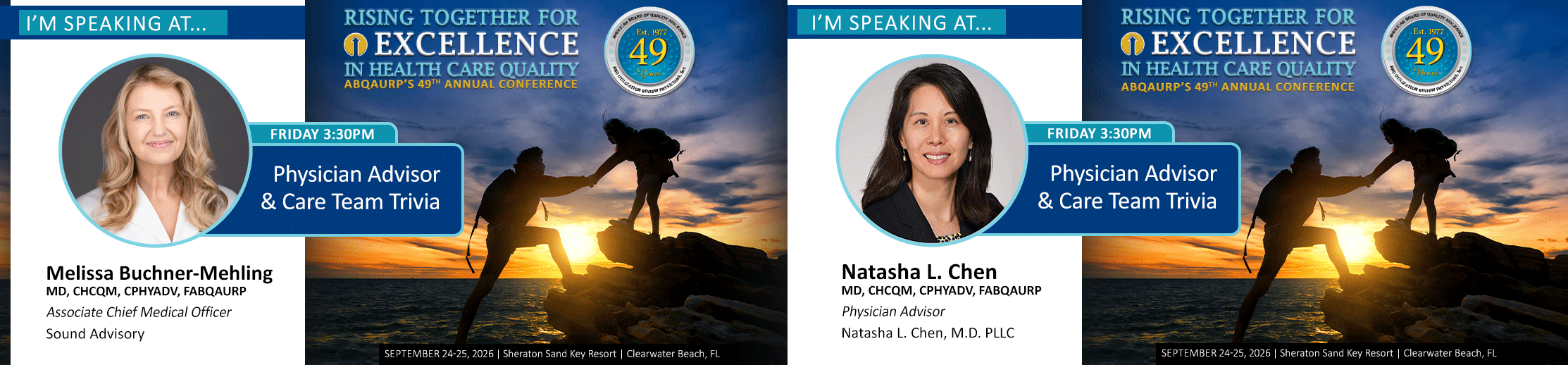
At ABQAURP’s 49th Annual Conference, attendees will have the opportunity to experience an interactive and high-energy educational session led by Dr. Melissa Buchner-Mehling and Dr. Natasha Chen. Titled “Physician Advisor and Care Team Trivia", this session takes a creative approach to reinforcing essential knowledge for physician advisors and health care team members by blending education with a game-based format inspired by the classic quiz show Jeopardy.
Rather than relying on traditional lecture methods, the presenters will guide participants through a series of 20 multiple-choice questions designed to test and strengthen their understanding of key topics central to physician advisor practices and health care teams. Each question will be displayed on slides followed by answer keys and detailed explanations that encourage discussion and deeper comprehension. The Jeopardy-style format fosters engagement, collaboration, and friendly competition among attendees, making complex regulatory and clinical concepts more approachable and memorable. Key learning concepts will include regulatory forms, patient costs, physician advisor roles, compliance, documentation, and billing best practices.
Active learning strategies consistently outperform passive approaches across a wide range of disciplines. In a large meta-analysis of undergraduate STEM courses (science, technology, engineering, mathematics), Freeman et al. (2014) looked at evidence from 225 studies and found that active learning improved examination performance and reduced course failure rates when compared to traditional lectures. In practice, active learning can consist of discussion, group work, asking and answering questions, completing self-tests, formulating notes rather than copying verbatim, and explaining concepts to others. Unlike passive listening, these activities increase cognitive effort and retrieval which are strongly associated with learning.
The trivia questions are intentionally selected to be applicable to multiple members of the interprofessional team, not just to physician advisors. At the same time, the topics highlight the breadth of knowledge and unique skills common to many physician advisors, including the ability to speak the “language” of case management, utilization review, finance, revenue cycle, coding, documentation improvement, and quality. Physician advisors often serve as liaisons between the C-suite and medical staff for this reason, able to discuss sensitive matters such as regulatory requirements, medical necessity, and audit risk, while providing education to peers on best practice, care progression, and payor behavior.
The interactive nature of “Physician Advisor and Care Team Trivia” makes it particularly valuable for individuals preparing for the ABQAURP Advanced Physician Advisor board certification exam. The session’s questions are designed to mirror the types of scenarios and knowledge areas that candidates are likely to encounter on the exam, similar to a quiz before a major test. As a result, attendees will not only reinforce foundational concepts but also build confidence in their ability to apply that knowledge under pressure.
Why are quizzes important? A meta-analysis by Sotola and Crede (2021) looked at previously published literature that examined 52 classes with 7,864 students, primarily college-level courses. It demonstrated that quiz performance was relatively strongly predictive of later exam performance and overall academic performance, including the odds of passing a class. Students with at least weekly quizzes tended to perform better on midterm and final exams compared to students who did not take quizzes. The results of the meta-analysis suggest there may be a strong link between frequent quizzing and student success.
A body of evidence also indicates that re-reading provides little benefit for long-term retention beyond the initial exposure to the material. Karpicke & Roediger (2008) reported that repeated re-reading of foreign language vocabulary words yielded lower retention than a single reading combined with retrieval practice. This finding suggests that re-reading alone does not reliably strengthen memory. The exception may be if enough time has elapsed for substantial forgetting to occur, which forces additional cognitive effort to rebuild meaning.
Finally, mass studying (or cramming) before an exam often produces short-term gains but weak long-term retention in part because learning is not consolidated over time into long-term memory. Bahrick & Phelps (1987), for instance, found that spacing study sessions over longer intervals substantially improved recall and retention of Spanish vocabulary words when compared with cramming, even when total study time was the same. The findings indicate that spaced studying supports better memory and improves the likelihood of successful retrieval over time.
Beyond examination preparation, the session offers a refreshing and engaging learning experience that emphasizes active participation. All 20 questions are either new or revised from last year’s session to challenge both new and returning conference attendees. The Jeopardy-style format encourages attendees to think critically, collaborate with peers, and learn from both correct and incorrect responses. This dynamic approach helps solidify understanding in a way that traditional lectures often cannot achieve. The session promises to be both educational and entertaining.
References:
Freeman, S., Eddy, S. L., McDonough, M., Smith, M. K., Okoroafor, N., Jordt, H., & Wenderoth, M. P. (2014). Active learning increases student performance in science, engineering, and mathematics. Proceedings of the National Academy of Sciences, 111(23), 8410–8415. https://doi.org/10.1073/pnas.1319030111
Sotola, L.K., Crede, M. Regarding Class Quizzes: a Meta-analytic Synthesis of Studies on the Relationship Between Frequent Low-Stakes Testing and Class Performance. Educ Psychol Rev 33, 407–426 (2021). https://doi.org/10.1007/s10648-020-09563-9
Karpicke, J. D., & Roediger, H. L. (2008). The critical importance of retrieval for learning. Science, 319(5865), 966–968. https://doi.org/10.1126/science.1152408
Bahrick, H. P., & Phelps, E. (1987). Retention of Spanish vocabulary over 8 years. Journal of Experimental Psychology: Learning, Memory, and Cognition, 13(2), 344–349. https://doi.org/10.1037/0278-7393.13.2.344
How Learning Actually Works According to Science | When Notes Fly